
Author: Advent Cry

  • Habakkuk Two Tables – The 1843 and 1850 Charts – Part 1

    Habakkuk Two Tables – The 1843 and 1850 Charts – Part 1

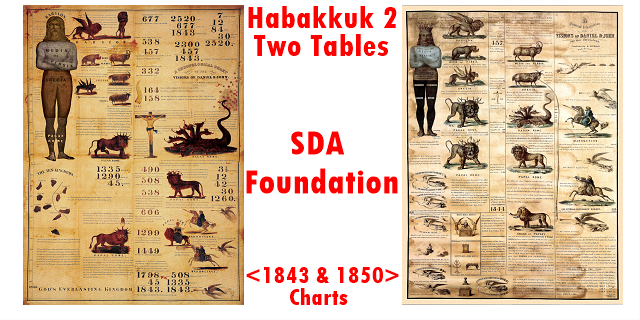
    In this study, we will be looking at the two tables mentioned in the book of Habakkuk 2 in the Bible. The foundation of the faith of Adventism will be highlighted from its beginning.

    It is important to note that it is in the Millerites’ historical time period that we have the formation of the foundation and pillars of the faith of Adventism.

    On these two tables or charts mentioned in Habakkuk 2, the historical waymarks of the Faith of Adventism are pinpointed and we will see from inspiration that this is how God wanted it to be and that these are the waymarks Adventism should follow without altering them.

    So let us begin by Reading (Habakkuk 2:1-4) It says 1  I will stand upon my watch, and set me upon the tower, and will watch to see what he will say unto me, and what I shall answer when I am reproved. 2  And the LORD answered me, and said, Write the vision, and make it plain upon tables, that he may run that readeth it. 3  For the vision is yet for an appointed time, but at the end it shall speak, and not lie: though it tarry, wait for it; because it will surely come, it will not tarry. 4  Behold, his soul which is lifted up is not upright in him: but the just shall live by his faith.”

    Here we just read from Habakkuk 2 that the vision should be written, and be made plain upon tables. Here we can see that this is a prophecy that must come to pass…


    So when did this Prophecy to Write the vision, and make it plain upon tables came to pass?


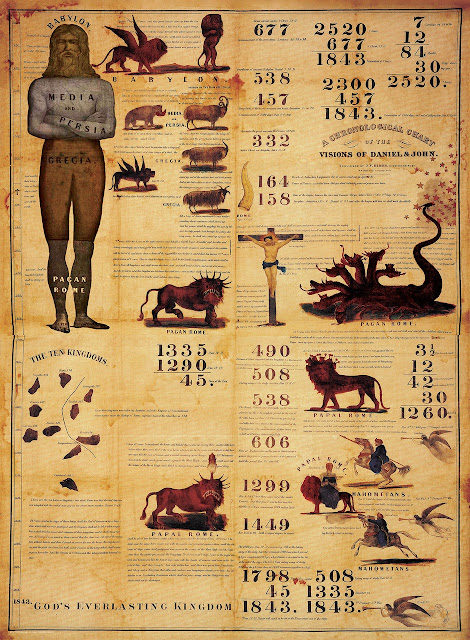
    Let us hear what the Word of God has to say. Reading from (Spirit of Prophecy, Volume 4, page 241 par. 2) It says “As early as 1842, the Spirit of God had moved upon Charles Fitch to devise the prophetic chart, which was generally regarded by Adventists as a fulfillment of the command given by the prophet Habakkuk, “to write the vision and make it plain upon tables.”{4SP 241.2}
    1843 chart

    So from what we have just read, we see that the prophecy of Habakkuk 2, had a fulfillment in the year 1842 “to write the vision and make it plain upon tables.

    Also, from the quote we have just read, it stated that it was Charles Fitch who the Spirit of God moved upon to create the prophetic chart.

    Now, here are a few questions from the quotations that we have just read from Ellen G. White:

    A) Who created the prophetic chart?
    Answer: Charles Fitch

    B) In what year was it created?
    Answer: 1842


    Nice. Let’s move on…


    So let us read another quotation from (Early Writing, page 74, par.1) It says “I have seen that the 1843 chart was directed by the hand of the Lord, and that it should not be altered; that the figures were as He wanted them; that His hand was over and hid a mistake in some of the figures, so that none could see it, until His hand was removed.” {EW 74.1}

    Here are a few more questions from the quote that we have just read:

    A) What was the first table/chart called?
    Answer: 1843 chart

    B) Whose hand directed the creation of this chart/table?
    Answer: God

    C) Should we alter or change what is on the chart/table?
    Answer: No

    D) Is this the way God wanted the figures to be on the chart/table?
    Answer: Yes

    D) Why was it called the 1843 Chart?
    Answer: Because they were expecting God to come in 1843


    We are doing great so far in this study. Let us continue…


    We have read about “tables” in Habakkuk 2 and we know that “tables” is plural, which means more than one.

    So here is the problem, we saw that it was only one chart/table created in 1842 while we read about more than one. So now we need to trace down and see where in history the second table/chart of Habakkuk 2 had its next fulfillment.

    We would like to begin by reading from ( Manuscripts Releases volume 13, page 359, par.1) It says “I saw that God was in the publishment of the chart by Brother Nichols. I saw that there was a prophecy of this chart in the Bible, and if this chart is designed for God’s people, if it [is] sufficient for one it is for another, and if one needed a new chart painted on a larger scale, all need it just as much.” {13MR 359.1}

    Let us also read this quote from (Manuscripts Releases volume 15, page 210 par.4) Which says “Monday we returned to Dorchester where our dear Brother Nichols and family live. There in the night God gave me a very interesting vision, the most of which you will see in the paper. God shewed me the necessity of getting out a chart. I saw it was needed and that the truth made plain upon tables would effect much and would cause souls to come to the knowledge of the truth.”  {15MR 210.4}

    Here we can now clearly see that Ellen G. White has gotten a vision from God about the chart that was published by Brother Nichols. She vividly stated that God was in the publishment and that there was a prophecy of this chart in the Bible and further, she stated that this chart serves to make the truth plain upon tables.


    So this second chart published by Brother Nichols was also a fulfillment of Habakkuk Chapter 2


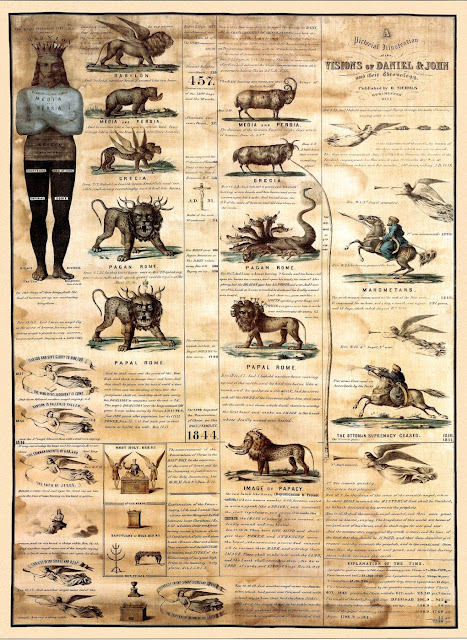
    Now this next quote that we are going to read is taken from a book published in the year 1977 by Pieter Gerard Damsteegt, called (Foundations of the Seventh-day Adventist Message and Mission, page 193, par.1) It says “In 1850 Nichols published a Pictorial Illustration of the Visions of Daniel & John designed by Samuel W. Rhodes.  On this chart the third angel was indicated by the motto “The Commandments of God and the Faith of Jesus.” {1977 PGD, FSDA 193.1}

    This other quote is taken from a book written by LEROY EDWIN FROOM called (The Conditionalist Faith of Our Fathers, Volume 4, page1071, par.2) It says “Then OTIS NICHOLS, engraver of Dorchester Massachusetts, a Boston suburb, published this first pictorial chart to be brought out after the Disappointment. Lithographed at Boston in December, 1850, it differs but little in general outline from the positions of the Millerites taught during the seventh month movement except in the expanded treatment of the sanctuary and the flight of the third angel. About 30 by 40 inches, it is arranged in four vertical columns. The second column, which is rather narrow, is confined to chronological data, while the three larger ones dial systamatically with the symbols.” {1954 LEF, PFF4 1071.2}
    1850 chart

    Let us answer some questions below from the quote we have just read

    A) Who created this next prophetic chart?
    Answer: It was designed by Samuel W. Rhodes and published by Otis Nichols

    B) In what year was this chart created?

    Answer: 1850

    B) What was this second chart/table called?
    Answer: 1850 Chart

    C) Why was it called the 1850 chart?
    Answer: Because it was created in 1850

    We have reached the conclusion of this study and from what we have understood or learned so far, it is clear from the Word of God that the tables of Habakkuk 2 had their prophetic fulfillment, one in the year 1842 and the other in the year 1850.

    Inspiration tells us that God directions were given in the creation of these charts and the one created in 1850 has the expanded treatment of the sanctuary and the flight of the third angel on it.

    We hope this study was a blessing to you and you should look out for part 2. God Bless.
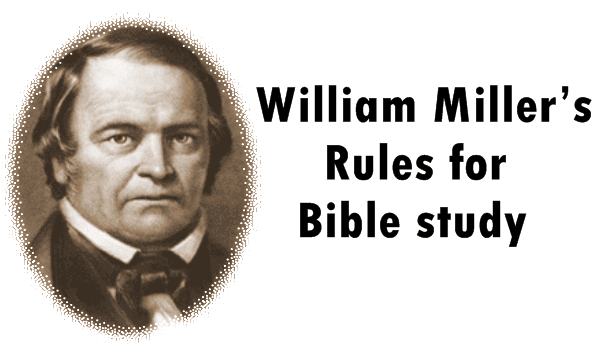
  • William Miller’s Rules for Bible study

    William Miller’s Rules for Bible study

    Studying the Bible is very important to our souls’ salvation, however, not understanding the scriptures might pose a challenge to us, with that said, our pioneers had laid a platform for us to follow in making this issue easy by using the correct application. DIVINE ENDORSEMENTReview and Herald November 25, 1884-Notes of Travel   “Those who are engaged in proclaiming the third angel’s message are searching the Scriptures upon the same plan that Father Miller adopted. In the little book entitled “Views of the Prophecies and Prophetic Chronology,” Father Miller gives the following simple but intelligent and important rules for Bible study and interpretation:

    1. Every word must have its proper bearing on the subject presented in the Bible; 2. All Scripture is necessary, and may be understood by diligent application and study; 3. Nothing revealed in Scripture can or will be hid from those who ask in faith, not wavering; 4. To understand doctrine, bring all the scriptures together on the subject you wish to know, then let every word have its proper influence; and if you can form your theory without a contradiction, you cannot be in error; 5. Scripture must be its own expositor, since it is a rule of itself. If I depend on a teacher to expound to me, and he should guess at its meaning, or desire to have it so on account of his sectarian creed, or to be thought wise, then his guessing, desire, creed, or wisdom is my rule, and not the Bible.”
    “The above is a portion of these rules; and in our study of the Bible we shall all do well to heed the principles set forth.” {RH, November 25, 1884} RULES OF BIBLICAL INTERPRETATION

    In studying the Bible, I have found the following rules to be of great service to myself, and now give them to the public by special request. Every rule should be well studied, in connection with the Scripture references, if the Bible student would be at all benefited by them.

    1. Every word must have its proper bearing on the subject presented in the Bible. Matthew 5:18

    2. All Scripture is necessary, and may be understood by diligent application and study.
    2 Timothy 3:15,16,17

    3. Nothing revealed in the Scripture can or will be hid from those who ask in faith, not wavering. Deuteronomy 29:29; Matthew 10:26, 27; 1 Corinthians 2:10; Philippians 3:15; Isaiah 45:11;  Matthew 21:22; John 14:13, 14; 15:7; James 1:5, 6; 1 John 5:13, 14, 15.

    4. To understand doctrine, bring all the Scriptures together on the subject you wish to know; then let every word have its proper influence, and if you can form your theory without a contradiction, you cannot be in an error.  Isaiah 28:7-29; 35:8; Proverbs 19:27; Luke 24:27,44,45; Romans 16:26;   James 5:19; 2 Pet. 1:19,20

    5. Scripture must be its own expositor, since it is a rule of itself. If I depend on a teacher to expound it to me, and he should guess at its meaning, or desire to have it so on account of his sectarian creed, or to be thought wise, then his guessing, desire, creed, or wisdom is my rule, not the Bible.
    Psalms 19:7-11; 119:97-105; Matthew 23:8-10; 1 Corinthians 2:12-16; Ezekiel 34:18,19; Luke 11:52; Malachi 2:7,8

    6. God has revealed things to come, by visions, in figures and parables, and in this way the same things are often times revealed again and again, by different visions, or in different figures and parables. If you wish to understand them, you must combine them all in one. Psalms 89:19;        Hosea 12:10; Habakkuk 2:2; Acts 2:17; 1 Corinthians 10:6; Hebrews 9:9, 24; Psalms 78:2;    Matthew 8:13, 34; Genesis 41:1-32; Daniel 2; 7; 8; Acts 10:9-16

    7. Visions are always mentioned as such. 2 Corinthians 12:1

    8. Figures always have a figurative meaning, and are used much in prophecy to represent future things, times and events; such as mountains, meaning governments; beasts, meaning kingdoms, waters, meaning people, lamps, meaning Word of God, day, meaning year. Daniel 2:35,44; 7:8,17; Revelation 17:1,15; Psalms 119:105; Ezekiel 4:6

    9. Parables are used as comparison to illustrate subjects, and must be explained in the same way as figures, by the subject and Bible. Mark 4:13

    10. Figures sometimes have two or more different significations; as day is used in a figurative sense to represent three different periods of time.
    • Indefinite.
    • Definite, a day for a year.
    • Day for a thousand years.
    If you put on the right construction it will harmonize with the Bible and make good sense, otherwise it will not. Ecclesiastes 7:14; Ezekiel 4:6; 2 Peter 3:8

    11. How to know when a word is used figuratively: If it makes good sense as it stands, and does no violence to the simple laws of nature, then it must be understood literally; if not, figuratively. Revelation 12:1,2;17:3-7

    12. To learn the true meaning of figures, trace your figurative word through your Bible, and where you find it explained, put it on your figure, and if it makes good sense you need look no further; if not, look again.

    13. To know whether we have the true historical event for the fulfillment of a prophecy: If you find every word of the prophecy (after the figures are understood) is literally fulfilled, then you may know that your history is the true event. But if one word lacks a fulfillment, then you must look for another event, or wait its future development. For God takes care that history and prophecy doth agree, so that the true, believing children of God may never be ashamed. Psalms 21:5; Isaiah 14:17-19; 1 Peter 2:6; Revelation 17:17; Acts 3:18

    14. The most important rule of all is, that you must have faith. It must be a faith that requires a sacrifice, and, if tried, would give up the dearest object on earth, the world and all its desires, character, living, occupation, friends, home, comforts and worldly honors. If any of these should hinder our believing any part of Gods word, it would show our faith to be vain. Nor can we ever believe so long as one of these motives lies lurking in our hearts. We must believe that God will never forfeit His word. And we can have confidence that He that takes notice of the sparrow, and numbers the hairs of our head, will guard the translation of His own word, and throw a barrier around  it, and prevent those who sincerely trust in God, and put implicit confidence in His word, from erring far from the truth, though they may not understand Hebrew or Greek.

    By utilizing these principles and by the help of the Holy Spirit, you are sure to highlight or unfold the wondrous truths that this little book called the Bible has instore.